GPT-1
Generative pre-training, then fine-tune
Paper: Improving Language Understanding by Generative Pre-Training (GPT-1) — Radford et al., 2018
The transformer was an architecture in search of its killer application. GPT-1 (Radford et al.’s 2018 Improving Language Understanding by Generative Pre-Training) found it, and in doing so defined the recipe that the whole field still follows: pre-train a language model on raw text, then adapt it. This is the chapter where our foundations objective becomes a general-purpose method.
The two-stage recipe
GPT-1’s framework has two stages. The first is the one we care about:
- Unsupervised pre-training. Train a high-capacity language model on a large corpus with the standard next-token objective: maximize . This is exactly the cross-entropy objective from our foundations, now used as the engine of general learning.
- Supervised fine-tuning. Adapt the pre-trained model to a labeled task by adding a single linear output layer and continuing training.
The radical claim was that stage 1 does almost all the work. Where prior approaches built bespoke architectures per task, GPT-1 used one pre-trained model and made only minimal changes to fine-tune it: often just a linear head and some delimiter tokens. This is transfer learningtransfer learningLearning general skills on one task (here, next-token prediction on huge text) and reusing them on other tasks. Pre-training plus adaptation is the transfer-learning recipe behind modern LLMs.See in glossary → in its modern form: the general skills learned by predicting text transfer to nearly everything.
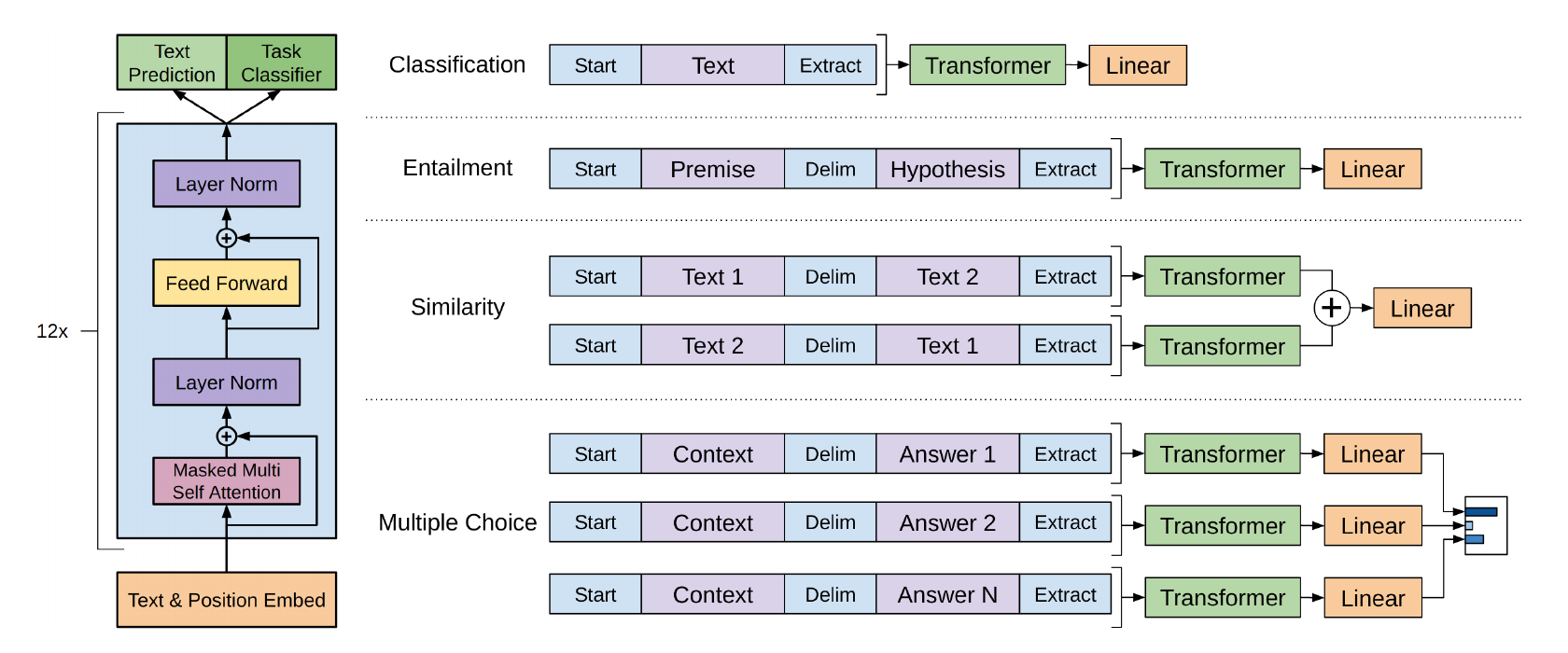
Figure 1 from Improving Language Understanding by Generative Pre-Training (Radford et al., 2018).
A decoder-only transformer
Architecturally, GPT-1 took the decoderdecoderThe half of a transformer that generates a sequence one token at a time using masked (causal) self-attention. GPT-style language models are decoder-only.See in glossary → half of the transformer — a stack of blocks with masked (causalcausal maskA mask applied before the attention softmax that sets future positions to −∞, preventing each token from attending to tokens that come after it. What makes a decoder autoregressive.See in glossary →) self-attentionself-attentionAttention where the queries, keys, and values all come from the same sequence, so each position can gather information from other allowed positions in that sequence.See in glossary →, so each position sees only earlier ones — and dropped the encoder entirely. This decoder-only design is the template for every GPT-family model since. The specifics:
- 12 layers, hidden size 768, 12 attention heads, feed-forward inner dimension 3072.
- About 117 million parameters.
- GELUGELUGaussian Error Linear Unit — a smooth nonlinearity used inside the MLP. SiLU/SwiGLU are common modern variants.See in glossary → activations, learned position embeddings, and BPEBPEByte-Pair Encoding — the most common tokenization algorithm. It merges frequent byte pairs into tokens.See in glossary → with 40,000 merges.
- AdamAdamAdaptive Moment Estimation — an optimizer that tracks running averages of the gradient (first moment) and its square (second moment) to give each parameter its own adaptive step size.See in glossary → with a peak learning ratelearning rateThe size of each parameter step. Too high and training can diverge; too low and it crawls.See in glossary → of 2.5e-4, linearly warmed up over 2,000 steps then cosine-decayedcosine decayA learning-rate schedule that follows a half-cosine curve from the peak down to a small floor, decaying slowly at first and fast at the end. The most common LLM schedule.See in glossary → to zero, the warmup-then-decay schedule from our optimizer chapter, in the wild.
The data choice that mattered
GPT-1 was pre-trained on BooksCorpusBooksCorpusA dataset of around 7,000 unpublished books (~800M words) used to pre-train GPT-1. Long contiguous passages made it good for learning long-range structure.See in glossary →: over 7,000 unpublished books. The authors were explicit about why books rather than, say, a shuffled sentence dataset: books contain long stretches of contiguous text, which lets the model learn to condition on long-range structure. A sentence-shuffled corpus of the same size would have destroyed exactly the long-range dependencies the model most needed to learn. This is the first appearance of a theme that never goes away: the structure of your data shapes what the model can learn, not just its quantity.
GPT-1 proved the recipe at modest scale. Its contemporary, BERT, made a different bet about the objective, and for understanding tasks, briefly won. That contrast is the next chapter.